1. With recent approvals of T-Cell Engager Therapeutics, particularly Tarlatamab-dlle from Amgen in 2024 for treating solid tumors, we have seen continued excitement within this space. What would you say have been the most exciting advancements within the last 12 months?
The most exciting development has been the continued clinical validation that T-cell engagers can become meaningful medicines beyond hematologic malignancies. Tarlatamab’s accelerated approval in extensive-stage small cell lung cancer in May 2024 was already a major milestone, but the field gained even more confidence when Amgen reported in 2025 that the Phase 3 DeLLphi-304 trial met its primary endpoint and showed a statistically significant overall survival benefit versus chemotherapy. That kind of progression - from first approval to confirmatory survival data - is exactly what a modality needs to move from promising to truly durable.
Beyond that, I think the last 12 months have shown real maturation in how the field thinks about next-generation design. The conversation is no longer just about whether T-cell engagers work, but how to make them safer, more selective, and more effective in tougher settings like solid tumors and even autoimmune disease. That shift - toward better target biology, smarter format engineering, and more precise patient selection - is what makes this moment particularly important.
2. We are now more than ever seeing lots of success within this field. However, what do you see as the greatest bottleneck which remains to completely unlock the full potential T-Cell engager therapeutics?
In my view, the biggest bottleneck is still the therapeutic window. The field has shown that we can redirect T cells powerfully. The harder challenge is doing that with enough tumor selectivity to generate strong efficacy without unacceptable toxicity, especially in solid tumors where antigen expression on healthy tissues, heterogeneous target density, and the biology of the tumor microenvironment all complicate the equation.
That is why I think the next major wave of progress will come from precision: better targets, better ways to discriminate tumor from healthy tissue, and better engineering to control where and when T cells are activated. If we can consistently widen that therapeutic window, we unlock much more than incremental improvement - we unlock broader indications, better combinability with other therapies, and ultimately more durable patient benefit. And that's precisely what informs how we think about target selection.
3. With the above in mind, lots of new companies are entering the T-cell engager field, but where does Deck Bio’s interest in this field come from and what are your motivations?
At Deck Bio, our interest comes from a very simple belief: T-cell engagers are one of the most compelling modalities in oncology, but their full potential in solid tumors will require a more precise targeting paradigm than the field has historically had.
Our focus is on TCR-guided T-cell engagers, which allows us to go after intracellular oncogenic biology through peptide-MHC targets rather than being limited to cell surface antigens alone. That opens access to a much broader universe of tumor associated targets and, importantly, enables a different way of thinking about specificity. Our motivation is to help push the field toward therapies that are not only potent, but also rationally engineered around tumor selectivity from the beginning. More broadly, what motivates us is the gap between what patients with solid tumors need and what current immunotherapies can reliably deliver. If we can improve selectivity and expand the set of actionable targets, we believe T-cell engagers can become a much more transformative option for those patients.
4. What is Deck Bio most looking forward to at the 8th T-Cell Engagers Therapeutics Summit and why do you think it is important this event takes place?
What we’re most looking forward to is being in a room with people who are all trying to solve the same core problems from different angles - discovery, engineering, translational biology, clinical strategy, safety, and CMC. T-cell engagers are a modality where progress is inherently interdisciplinary, so having a forum built specifically around the end-to-end challenges of the space is incredibly valuable. That is also why this event is important. The summit is explicitly centered on advancing safer and more effective T-cell engagers in solid tumors, while also highlighting the expansion of engager biology into new disease areas. At a time when the field is seeing more clinical validation, more partnerships, and more nextgeneration programs moving toward the clinic, events like this help translate momentum into faster learning and better decision-making across the ecosystem.
5. What insights will you be sharing with our audience at the event this June?
We’ll be sharing our perspective on how to design T-cell engagers for solid tumors with specificity as a foundational principle rather than an afterthought. In particular, we plan to discuss how TCR-guided approaches can expand the addressable target landscape by accessing intracellular tumor antigens presented as peptide-MHC complexes, and why that matters for building the next generation of solid-tumor TCEs.
We’ll also speak to the broader question of what it takes to make these programs clinically relevant: how target selection, format design, and off-tumor risk assessment need to work together from the earliest stages of development. Our goal is to contribute a practical perspective on how the field can move beyond proof of concept and toward more durable, differentiated therapies for patients with solid tumors.
Explore the Full Event Guide
- 120+ Industry Attendees
- 28+ World-Class Speakers
- 8+ Hours of Unrivalled Networking Opportunities
- 6 Deep-Dive Workshops
- 1 Modality at the Front & Center
- The Only Industry Forum Dedicated to Advancing T-Cell Engagers to Transform the Oncology and Autoimmune Landscapes
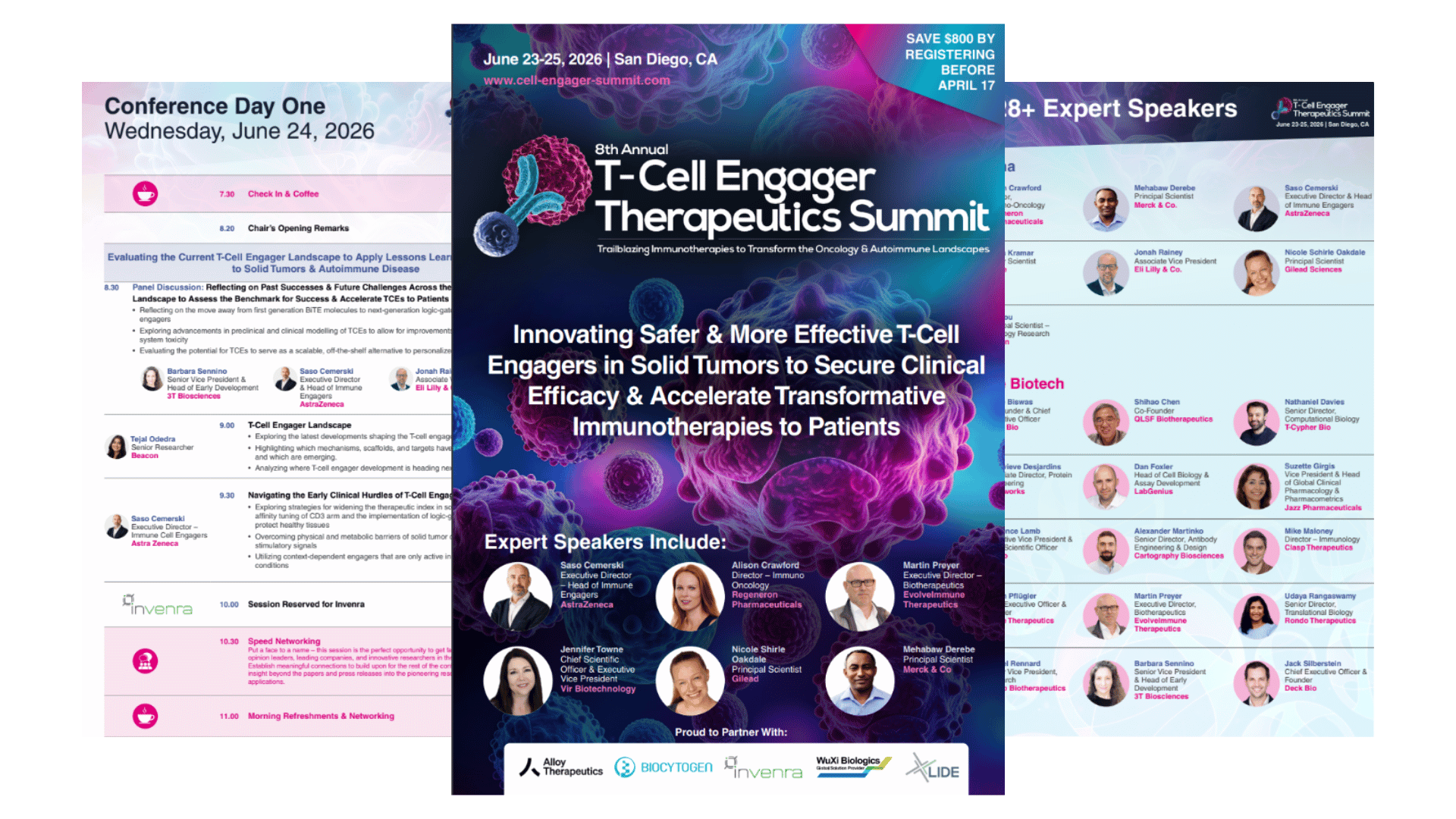
Explore the Brand-New Agenda
Hear the latest industry breakthroughs in T-Cell Engager development and gain exclusive modality and platform insights during our packed agenda.
Partner With Us
Position yourself as the go-to service provider of the rapidly progressing T-Cell Engager landscape to ensure your brand is at the heart of deals in this evolving space.
Join Biopharma Experts
Be part of the most critical conversations shaping the future of solid tumor and autoimmune therapy, where you can connect with like-minded experts across every stage of drug development.